Monday, December 14, 2009

A Hidden Paradise for The Empress


The Empire Hotel & Country Club Brunei

Whenever Brunei is mentioned, people always relate it to oil and say that it is one of the richest countries in the world. Apart from being a prosperous Muslim country with ancient monarchy, what is so special about Brunei? I asked myself the same question until the day I visited that country and discovered that there are so many places of interest and things to do over there. Of course most of the architectures such as the mosques are gold-plated! Then, one day I found a hidden upscale piece of paradise that not many people are aware of (which surprised me actually) – The Empire Hotel and Country Club.

The Empire Hotel and Country Club is located in Jerudong, about 15 minutes from Brunei Interational Airport and 20 minutes from Bandar Seri Begawan, the capital and central business district. Staying at a prestigious five-star hotel but with seven-star standard was one of my dreams and never thought it could come true with just one email that invited me to stay there for few days. It was an honour and something that I could not refuse!

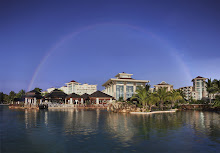
Photo by Karen Tukalan-Pinn: The Empire Hotel & Country Club Brunei

Driving through the hotel’s main gate, you would love the green landscaped garden and trees – so relaxed and welcoming. On the left side, there is a big building with a “The Empire Theatre and Cinema” sign. Oh my goodness, a hotel with its own theatre and cinema? I must say this is something rare and don’t think you can find many hotels around that provide such facilities.


Photo by Karen Tukalan-Pinn: The Empire Theatre and Cinema


Finally arrived at the hotel, I was warmly welcomed by some genuinely friendly staff. The awe-inspiring architecture with fine marbles from Italy and gold-plated finish is something that would definitely amaze everyone and you will feel like a ‘royalty’ right away.

Magnificent gold-plated architecture


The Main Lobby

Entrance to the Main Lobby

An attentive staff member escorted me to my luxurious suite with separate living room, where I discovered complimentary fruit basket, a platter of freshly baked cookies and something that I cannot resist, the hotel’s signature chocolates placed in a made-of-chocolate salver and sprinkled with edible gold dust. All cutleries inside the suite, in fact throughout the hotel, are made of pure silver.

Photo by Karen Tukalan-Pinn: The Executive Suite

Photo by Karen Tukalan-Pinn: The Empire's signature chocolates placed in a made-of-chocolate salver

I contemplated first the view from the wrap-around balcony over the manicured landscape garden, blue ocean and nine swimming pools. Bursts of colour in the suite mirror the landscape. The spacious suite is covered with carpets made of the finest wool from New Zealand while the bedroom itself can sleep the whole family in there. The bed and beddings are so comfortable that I look forward to my good night sleeps. Everything inside the room is enhanced with modern gadget that is just a click-of-button away. Even to close the curtains, I only had to press a button. I really like the bathroom – so huge and luxurious – clad in light brown and white marble slabs. It seems that the suite is prepared for some romantic getaway as the bathtub is spacious enough for two and a separate glass shower stall leaves the choice to you; and a separate glass cubicle for toilet too. So I bet you can visualize how big the bathroom is.

Photo by Karen Tukalan-Pinn : The view of the landscaped garden from the balcony
Photo by Karen Tukalan-Pinn : Luxurious bathroom with exquisite Italian marble slabs

The Empire’s signature lemongrass bathing poducts are a pleasant surprise, from shower gel to shampoo, conditioner and lotion. After the first application, I was hooked and ready to try the spa!

That afternoon, I was transported by using a buggy to the The Empire Country Club where the “East meets West” fusion spa is located on the basement floor of the building. In a changing room with huge jacuzzi, I got changed and slipped into a bathrobe before my therapist, Utti, escorted me to my treatment room. Basically, you can choose various of selections that you prefer from the extensive spa menu. Yet I chose the Balinese massage, a traditional Balinese massage techniques heightened with Swedish massage. Utti applied some massage oil and used thumbs pressure to the various points of my body especially on the neck, shoulder and back. For a young woman, Utti's touch was strong and deft and she located areas of stress that need unknotting without me having to guide her to them. It was a wonderful feeling to be in the good hands of someone who gave a fabulous massage, checking with me a couple of times to make sure the pressure was just right: It always was.

Rejuvenating spa treatment

The 1 hour and 15 minutes treatment was so relaxing that I actually dozed off for a while (a good sign of enjoying it) and I was awakened by a soft pat on my shoulder. I felt my whole body was as light as the feathers when I got up which was a positive response – the strained muscles have been shifted into place and out of tension. A cup of warm ginger tea after the treatment was a refreshing ending to the revitalizing journey.

Inside The Empire Country Club, you can also enjoy facilities and activities such as tennis, squash, badminton, indoor swimming pool, eight-lane ten-pin bowling, gymnasium and more.

Water slides by the pool

Photo by Karen Tukalan-Pinn: Spectacular sunset - view from the swimming pool

I will never forget the E-Club Lounge on the 6th floor which offers personalised butler services and complimentary breakfast, high-tea, evening mocktails and international hors d’oeuvres to those staying on the E-Club floors.

E-Club Lounge


My "perfect second day" was capped with a fine dinner even without the wine (you do not necessarily need the wine to complement a sumptuous dinner) at Spaghettini, the Italian restaurant. But you can choose to dine at any of the restaurants on site – choices from Chinese to alfresco, international buffet and more.

Spaghettini restaurant


Photo by Karen Tukalan-Pinn: Roasted slice of beef leg with gremolata and Sardinian cous cous

18-hole Jack Nicklaus’ signature golf course is yet another feather at the hotel and you can even enrol in the golf school to improvise your golf skills.

18-hole Jack Nicklaus's signature golf course

But I decided to see more of the hotel and surroundings and indeed was lucky when given a tour inside the Emperor Suite and Empress Suite on the top floor – where the rich and richest icons have stayed before. The best features are the indoor swimming pool and sauna.

Photo by Karen Tukalan-Pinn: The indoor swimming pool inside The Emperor's Suite

Photo by Karen Tukalan-Pinn: Inside The Empress' Suite

My explorations at the hotel were a success and I was left with a whim to reflect back on the unforgettable getaway. Whether you are looking for some excellent food, golfing or the spa, there is always something for everyone.

Monday, June 15, 2009

The Dusun Lotud ‘Milamak’ Wedding

Living in heterogeneous and culturally diverse Sabah gives you the opportunity to witness numerous customs of more than 30 ethnic races and wedding ceremonies – modern as well the traditional ones.

Count yourself fortunate if you have the opportunity to attend a Dusun Lotud wedding. The fascinating wedding ceremonies and festivities give expatriates as well as locals a unique outlook to gain insight into the Dusun Lotud culture and social ethinicity. The Dusun Lotuds are indigenous ethnic group residing in Tuaran district and also known as the Kadazandusuns.

I was lucky that I got to witness a re-enactment of a full Dusun Lotud ‘Milamak’ wedding ceremony at a cultural village. Even though it was not an actual wedding, but I was informed that this ceremony is still strongly practised in the Dusun Lotud community... so it was like attending a real wedding anyway.

Before getting married, the family of the groom-to-be had to ‘monunui’ or visit the family of the bride-to-be to seek permission for both bride and groom-to-be to get married. At the same time, both families had to discuss on the ‘berian’(dowry) which normally comprise of money, water-buffalo or cow (to be slaughtered on the wedding day) and other items that are requested by the family of the bride-to-be. During the ‘monunui’, the groom-to-be and bride-to-be were officially engaged and exchanged rings while being witnessed by their family members. A week later, the couple got married. However, nowadays most couples want to wait for six months up to one year before they get married so that they will have ample of time to prepare for their weddings.

On the wedding day, the bride wore the complete Dusun Lotud traditional costume which I think was the most comprehensive gear that I had ever seen... especially on a bride! The ‘Sukub Kopio’ is a long-sleeved black cotton tailored blouse with red tinobogi (needle-weaving technique of interlaced flanel stitches) at the seams, a curvilinear motif of a bamboo shoot with sequins decorates the cuffs while gold threads are couched onto the fabric. ‘Tombuku’ (golden coins) sewn onto the ‘Sukub Kopio’ are used to button it up. A very long colourful cloth was wrapped around the bride’s upper body part – from chest to abdomen. The knee-length black cotton tube skirt is called the ‘Gonob’. Around the hips is a strip of tinobogi with a panel of Linangkit’, a hand-woven cloth using multi colour threads, sewn from the waist down. The gonob is held up by a strip of white cloth or what they call the ‘haboi’. Sometimes, a batik sarong is worn over the short ‘gonob’ to avoid exposure of the legs especially when sitting down. The bride’s accessories included the ‘Lilimbo’ (red wide girdle of interconnected loops of split rattan worn around the hips), ‘Loti’ (a chain of small silver coins placed in the middle of the ‘Lilimbo’, ‘Porotina’ (silver belt with a diamond-shaped clasp), Sigar (a headband with red rattan rims. The narrow band is decorated with rectangular or square plates of embossed goldleaf or modern substitute), ‘Simpai’ (hollow upper arm bracelets made of embossed silver), ‘Lansung’ (hollow and embossed silver anklets), ‘Mandapun’ (stiff ornamental collar of red cotton with embossed and leaves-shaped gold or silver plate), ‘Siwot’ (ornament for the head which is stuck into the hairbun and consists of four bunches of red cloth and black cock feathers with strings of silver-green beads with bits of red cloth dangle over the forehead from the first bunch, and downward from the last one) and ‘Karo’ (a necklace made of mostly long barrel beads of glass, shell and carnelian. In between these are hollow silver beads and concave ornaments over a wooden base. Usually two or three karo are worn together with cone-shaped ornaments which are arranged symmetrically with the points downwards). As I said earlier, there are loads of knick-knacks and details when it comes to the bride’s costume, but it contributed to the uniqueness of the whole wedding ceremony.


Photo by Karen Tukalan-Pinn: Bride getting reading on the wedding day

When the bride was all ready, her mother and bridesmaid escorted her to the groom’s house, while other family members and relatives followed from behind. At the front yard of the groom’s house, a group of elderly women or priestesses were standing in two straight lines. Three other priestess were holding a large piece of cloth in open semi-circle and the groom with his bestman were standing inside it, on a piece of bamboo mat.


Photo by Karen Tukalan-Pinn: Bride arrived at the groom's house

Photo by Karen Tukalan-Pinn: Bride and groom standing in the semi-circle cloth with priestesses

The groom was clad in full Dusun Lotud costume which consisted of ‘sukub’ (a black cotton shirt with similar decoration as the women's blouse), ‘Binandus’ (black trousers with a square piece of ‘linangkit’ at the back just under the waist) and ‘Sundi’ (a dastar or head gear). Similar to the bride, groom also wore some accessories such as the ‘Supu’ which is a silver chain with an attached round silver tobacco container (worn around the waist) and two pieces of Ulungkaris’ (also known as ‘Tatarapan’) which are actually the normal keris or dagger, a stiff red cotton belt with a big chunk of embossed oval and flowery-shaped gold plate and a ‘karo’.

So back to the ceremony! As soon as the bride arrived, all of the priestesses started to ‘Bandak’ or sing some continuous Dusun Lotud rhyme which sounded more like mantra to me. I was told that the ‘Bandak’ is just like chanting but most commonly used during a wedding ceremony to bless the newlyweds.


Photo by Karen Tukalan-Pinn: Groom's mother welcomed the bride


The groom’s mother welcomed the bride by placing a ‘Karo’ around her neck as a symbolic of giving her approval and warm welcome to the bride as a new member of the family. The bride then stood next to the groom inside the semi-circle cloth, facing the group of priestesses. The head of the priestesses started another round of ‘Bandak’ followed by the rest of the priestesses. Once they stopped, the family members at the ‘soriu’ or veranda played the gongs and ‘kulintangan’ (small sets of gongs) while the priestesses performed the traditional dance, ‘Sumayau’. Every movement of the hands was in harmony with the rhythm of the gong music although the feet movements were slightly slower, looked like walking with very small steps in an unhurried manner.


Photo by Karen Tukalan-Pinn: Priestesses doing the 'bandak' - blessing the newlywed


Photo by Karen Tukalan-Pinn: Priestesses performed the 'Sumayau'


Photo by Karen Tukalan-Pinn: Family members or relatives playing the kulintangan and gong

Once the gong music stopped, the head of the priestess led the other priestesses to enter the groom’s house while reciting the ‘milamak’ which they regarded as pristine blessing and a custom way of inviting the bride and groom into the house. The newlywed couple and their family members then entered the house and proceeded to the wedding dais inside the house. Then, the bride and groom fed each other with two to three mouthful of steamed rice as a symbol of unity. They sat at the wedding dais for quite a while so that relatives and friends can have a closer look at the newlyweds... and some even wanted to take photographs of the couple as well as themselves with the couple, for remembrance.

Photo by Karen Tukalan-Pinn: Newlyweds at the wedding dais

All in a sudden, the village’s elders started the ‘Bandak’ at the veranda and followed by the priestesses. This marked the beginning of the ‘Moninjau’ or ice-breaking session with the elders. While the bride and bridesmaid waited at the wedding dais, the groom and his bestman brought two plates of steamed rice and walked out to the veranda to sit with the elders and priestesses. They sat down facing the elders and placed the rice in front of them. The elders put the ‘kirai’ (hand-rolled cigarettes derived from dried leaves) and ‘sigup’ (tobacco) on a plate and poured the ‘bahar’ (dark orange coconut wine) into a bowl which are placed in the middle – between them and the groom. Then, a family member served some fried and boiled ‘ikan basung’ or sardines which were also placed in the middle. The elders told the groom and his bestman to start eating while they did the ‘Bandak’ together with the priestesses – a blessing for the groom to start a new life as a married man. Once they had finished eating, the elders started to drink the ‘bahar’ and passed the bowl around among themselves included the groom and and his bestman. After that, everyone joined in the feast.

Photo by Karen Tukalan-Pinn: Groom with the elders
Photo by Karen Tukalan-Pinn: The groom and his bestman had their meals while the elders and priestesses were doing the 'Bandak'
Photo by Karen Tukalan-Pinn: Passing around the 'bahar' between the elders and the groom

I was informed by one of the elders that normally the feast would last for the whole day and night. Some of the Dusun Lotud families prefers to have the wedding and feast at the bride’s house first, where the groom will go there on the wedding day and stay for a week. Then a week later the wedding ceremony continues as they escort the newlyweds to the groom’s house. There are also big number of families who combine both traditional with western wedding culture. But whatever it is, I must say that I was totally astounded by the whole process of the Dusun Lotud ‘Milamak’ wedding ceremony and it was an honour to experience it. This wedding ceremony is totally unique and one of its kind as it can only be seen in Sabah.


Remarks:
This editorial is also published in the following:

Tuesday, June 2, 2009

Big Bikers Roared Around Sabah


After a successful event last year, it was time for the Harley Owners Group Sabah Chapter, also known as HOG, to have another rally around Sabah.


Last year, HOG collaborated with a five-star resort in Kota Kinabalu and raised RM71,433 for charity through the auction of a 105th anniversary special edition Harley (the “Ultra Classic Electra Glide”), a lady’s leather jacket, a man’s leather jacket, a custom-printed T-shirt, two special pewter plaques and a Harley Davidson staff shirt during a charity dinner at the resort.

Proceeds of the auction will be donated to two local charity organizations namely Seri Mengasih Centre and Beringgis Children’s Home and to “Care For Children” a corporate social responsibility programme supported by the Shangri-La Hotels and Resorts group.

It was interesting to hear when Choo Kai Mun, the president of HOG Sabah Chapter, said that the rally was not only meant for members of HOG to get together but also to play their role in corporate social responsibility and give something back to the community.

“As Harley-Davidson owners we also rally to discover new rides, make new friends, and visit with old friends. We laugh, we party, and we find new adventures. When motorcyclists are welcomed by a biker friendly area we know we have a unique opportunity to be a part of a special motorcycle rally experience,” Choo added.


This year, the nine-day 6th Malaysia National HOG Rally commenced from 16 to 24 May and brought together hundreds of Harley Davidson owners and enthusiast from all over Malaysia, Australia, Brunei, France, Indonesia, Macau, Singapore, Thailand and the United States of America. I would say that this year the HOG rally is living the bikers’ dreams - travelling the road less travelled where adventure looming around every bend and plethora of roads from Tawau, Semporna, Lahad Datu, Sandakan, Ranau, Kudat, Kota Belud to Kota Kinabalu.


The first day in Tawau was only for registration as well as briefing of the rules and regulations for the bikers. Numerous type of Harley Davidson bikes that you have never seen before were on display and each one of them had to be refueled and gone through the safety inspection followed by a welcome dinner hosted by the Tawau Town Council at Marco Polo Hotel.


It was an early start the next day, breakfast as early as 7:00 am. At 8:00 am, most of the bikers were festooned in memorabilia consisting of patches and badges sewn or pinned onto venerable leather jerkins and traditional biker wear, were getting ready for the flag off at Tawau Town Council. In groups, the bikers roared out of Tawau with their “thunderous rides” and rode along roads fringed by palm oil estates to Semporna where they had a transfer by fast boats to Mabul Island for lunch and check-in. After a long ride, the bikers spent the whole day in Mabul with just lazying around, swimming, snorkeling and even scuba dive at Sipadan, rated to be the world’s top five diving spots.


Since they had to spend two days in Mabul, the bikers took the opportunity to visit the sea gypsies - the Bajaus, in their temporary quarters on the island. HOG has also been actively involved in conserving the the environment. On the second day in Mabul, bikers who are also qualified divers took the live corals they found on land and planted them on the ocean bed. A commemorative plaque stated “HOG International has laid this bed of corals in its efforts for conservation of our seas” was securely placed on the bed of corals. This effort and activity was the first ever done by any bikers group and those corals will be monitored and maintained by the Malaysian Fisheries Department.


Another early morning on 19 May when the bikers had to rise at dawn and had breakfast at 6:00 am in order to catch the boat transfer to semporna at 7:00 am and then headed off to Sukau where they got on a river cruise down the Kinabatangan River to spot wildlife in their natural habitat. The cruise itself was an adventure as the cruise had to overtake river debris like logs, crocodiles and even dead bodies (yaiks!). Kinabatangan River is well known among the villagers because they managed to capture a huge crocodile that had feasted on six villagers a while ago. Well, you definitely do not want to fall into that river ever! At noon, the bikers stopped by at a riverside restaurant for lunch while enjoying the nature.


The following day, the bikers had to go through a long and winding road to the Borneo Rainforest Consevatory in Ranau. Sabah has the oldest rainforest that is more than million years old ... so back to Mother Nature again! Getting on a canopy walk at the Borneo Rainforest Conservatory enabled everyone to have a closer look of the oldest trees and a glimpse of Mount Kinabalu. Around 12:30 noon, the bikers group arrived at Kampung Luanti in Ranau, a place famous for “fish massage” among the locals as well as tourists. Everyone got into the stream where a school of fish would “attack” - biting or sucking on dried skins off the human bodies. I must say that those who are very ticklish may want to think twice before getting this infamous fish massage.
The villagers around were amazed when a group of bikers wearing black leather jackets on big motorbikes riding past them. Even when these bikers had lunch with the villagers, you can see that everyone was whispering and smiling – it was a rare experience for the villagers to be visited by a big group of bikers.


On the way to Kota Kinabalu, these bikers just could not resist to stop at the town of Nabalu for some photography sessions and they were lucky enough that they got a clear view of Mount Kinabalu in the background. That evening the bikers called it a day at a resort in the city... time to re-energize and relax the cramped muscles.

After breakfast the next day, everyone had their gear on and was ready to hit the road – next destination was the tip of Borneo, Simpang Mengayau. Some part of the roads were gravel which made the journey a bit slow. However, they finally arrived at the tip of Borneo after three hours which was not too bad. A quick group photography session and they had to start moving to Kota Belud, the town of “Cowboys of the East” (The Bajau horsemen). The most interesting thing about a Bajau horseman is his horse or rather pony. It has its own costume and is more gaily dressed than the rider. Some of the bikers had the opportunity to ride on a horse and also water buffalo – a great experience for those who come from outside of Malaysia. On the way back to the city, they had a spectacular view of the Borneo sunset from the highland.


The next morning, the bikers roared out of the resort to the Monsopiad Cultural Village located in the district of Penampang, about 20 minutes away from the city. It is the only cultural village in Sabah built to commemorate the legendary Kadazan and head-hunter warrior – Monsopiad. A visit to the House of Skulls where more than 42 skulls are hung from the ceiling was one of the attractions in the village. The bikers decided to have their lunch at the cultural village while being entertained by live traditional dance performance. Then, they returned to the resort to freshen up and rest before they rode on their bikes again to the city council (Dewan Bandaraya Kota Kinabalu) that evening for dinner. The locals were welcomed to join in the bike games under floodlights simultaneously whilst the bikers enjoying their ‘tucker’... indeed a not-to-be-missed by the locals as they learned how to handle the bike, pick it up, take corners and much much more.


On the eight day, the bikers hit the road to Kiulu right after breakfast. It was a day for a white-water rafting adventure and trust me these bikers are not the faint-hearted kinds at all! After almost three hours of rafting along the rapid river, everyone finally reached the other end of the river...and a barbeque lunch was a perfect ending. Once reached the city, they headed to the port to arrange for shipments of their bikes then returned to the resort for a farewell dinner hosted by the Sabah Tourism Board.


After eight exhilarating days biking around Sabah, it was finally the end of the 6th HOG Rally! The HOG brothers and sisters reluctantly had to say goodbye to each other but took the friendships and memories home with them. For Harley Davidson fans who plan to join the group will have a year to polish and improvise their bikes for the next rally in May 2010.


Remarks:
This editorial is also published in the following:
*
http://www.etravelblackboard.com/showarticle.asp?id=93377

Friday, May 29, 2009

Mystical Sabah – A Journey of Worthwhile Experience


Photo by Karen Tukalan-Pinn: Sabah Fest 2009

Photo by Sabah Tourism Board: Sabah Fest 2009

If you think Mardi Gras or Oktoberfest are flamboyant and colourful, wait untill you see the spectacular Sabah Fest in the Land Below the Wind, which is an annual event organized by Sabah Tourism Board. Sabah Fest 2009 kicked off on 2 May 2009 and had successfully bedazzled the locals and visitors with its vibrant cultural extravaganza with this year’s theme “Mystical Sabah”.

The fest was a prelude of a month-long celebration in concurrence with the Harvest Festival and the first two days at Magellan Grand Ballroom in Sutera Harbour Resort were mainly showcasing some of Sabah’s ethnic groups through traditional songs and dances combined with a display of rarely seen rituals and scenes of their daily lives. When I was invited to attend the cultural show on the first night, I just could not say “no”. After hearing a lot of remarkable feedbacks from so many people on the Sabah Fest last year, I knew for sure that this was something that I had to witness myself – seeing is believing. Even being a local here, it is still interesting to learn a lot more about other ethnic races and their culture or traditions.

It was interesting how the entrance of the ballroom was set up with bamboos and a group of women fully clad in traditional costumes welcomed visitors with friendly smiles. As I walked down the stairs to the grand ballroom, the walkway was all covered with black cloth to make it looked as if you were entering a cave. “Skulls” were hanging on both sides of the walkway which shifted you back to the era of headhunters – back in the olden days, the Kadazans and Muruts were known as the headhunters and skulls symbolized the warriors’ strength. The more skulls collected the higher the warriors were ranked in their community.

At the ballroom foyer, there were numerous booths exhibited local crafts, traditional games, arts and paintings – basically almost everything was on display – something that never ceased to attract your attention and kept you amazed as you strolled along the foyer. Four young boys were showing off their skills in top spinning or gasing. The gasing is quite big and heavy so it was rare to see young boys spinning the gasing because it requires skills of great dexterity and precise timing. Then, there was a group of young boys and girls demonstrated to the tourists on how to play the popular traditional game called congkak.

I was captivated with the mock village setup of the Lotud tribe from Tuaran – the Linangkit Cultural Village. Linangkit refers to a hand woven selected cloth using multi colours thread (normally red, yellow, green, blue, maroon and gold) which is the significant costume decoration for the Lotuds. Linangkit is the striking feature when worn together with the Lotud’s black ceremonial costumes. From the circular sashes, knee-lenth skirts the back waistband of men’s trousers (called binandus), all are embellished with Linangkit. The one that was on display that evening was about 12.5 metre long which rated it as Sabah’s longest hand woven Linangkit. I was informed that a physically challenged (deaf and mute) woman, Julita Gayang, spent nearly every day over the two and a half years weaving that stunning and full of details masterpiece.

Everyone was also given the opportunity to have a glimpse of the mock Lotud wedding. The bride and groom in full Lotud costumes sat on a beautifully decorated four-post bed while being surrounded by their family members, also bedecked in their colourful traditional costumes. The Lotud community strongly believe that every festivity should be celebrated in big scale involving all family members.


Photo by Karen Tukalan-Pinn: The longest Linangkit in Sabah


Another interesting display was a chain of fangs that the Lotud priestesses believed to be the “fangs of thunder” and this item is nornally used together with a slaughtered chicken during a cleansing ritual. Then, there was a section where they placed the 200 years old “gusi” of sacred jars which are the main spiritual paraphernalia for the Lotuds. The Lotuds regard the “gusi” as a place where their ancestors’ spirits rest peacefully. Seeing all these spiritual bits and pieces gave me some goose-bumps especially when recorded ritual chanting was played in the background because I can imagine how the actual ritual ceremony was conducted by bunch of priestess in black costumes to cast away evil spirits. A little bit mystical but the whole ritual thingy was an interesting fact to know.
Photo by Karen Tukalan-Pinn: 200 years old sacred jars

Photo by Karen Tukalan-Pinn: Fangs of Thunder

I continued strolling along the foyer and saw more eye-catching exhibitions such as the Bajau craftsman from Kota Belud making some of their signature handicrafts, Bajau Laut craftsmen from Semporna giving a live demonstration on making miniature lepa or single masted sailing boat, a Lundayeh woman making colourful bead works and a lot more.

I can easily spend the whole day browsing through each booths during the fest but I had to be in the ballroom for the much anticipated cultural show and I did not want to miss any second of it. There were so many people seated in the ballroom and I noticed that there were many tourists too, guess they also wanted to enjoy the natural charms of Sabah that night.

Lights were switched off and the show began with short sketch of a “grandmother” and her “grandson” standing on the stage and sort of telling a story (they were just miming what the emcee was saying) of the Lotud tribe before they walked down to the hut at the left corner of the stage. After that, a group of women in black costumes with long veils lined up on the stage and started to dance following the beat of the gongs, a short but entertaining intro.

Then, the Tantagas of high priestesses with 80 followers chanting away from the back of the ballroom until they got up on the stage. This was the first time that Sabah Fest ever showcased this rare Lotud ritual of “Mamahui Pogun” or cleansing of the universe, which is a lost-in-time ceremony to appease the spirits and restore the balance of the universe. During the “Mamahui Pogun”, a group of 30 young children performed the sumayau (traditional dance of the Lotud tribe) as part of the ritual.

Photo by Karen Tukalan-Pinn: Mamahui Pogun ceremony

From a spiritual ceremony, the whole atmosphere was transformed into a fast pace performance by the Bajau tribe of Kota Belud or also known the “cowboys of the east” – except without the horses! The mock tamu scene complemented the popular economic activity amongst the Bajau people.

Pangalay Agung, the traditional dance of the Suluk people from Sandakan, was attention-grabbing too. It also told the story of how the dance was drown from the legend surrounding the a female Suluk aristocrat with mystical powers that did not allow her feet to touch the ground. Therefore, the Pangalay Agung has been regarded as a royal welcoming dance.
.

Photo by Sabah Tourism Board: Pangalay Agung Dance

Photo by Karen Tukalan-Pinn: The a female Suluk aristocrat with mystical powers

Next highlight was the Brunei people who performed their dance and songs while playing the Gambus, a traditional lute which has its origins in the Middle East. What make this Gambus unique is what it made of – carved out of jackfruit wood (with inticate carvings on its body) and the bore is covered with either lizard or goat skin.

Photo by Karen Tukalan-Pinn: Brunei tribe with gambus

The Mongigol Sumundai which is a dance of the Rungus tribe, Monsilad (Dusun Gana) and Anggalang Manunatip (dancing with the bamboo) were among the other dance performance that I enjoyed that night before everyone was invited to join in the merry-making which marked the end of the festivity.


Photo by Sabah Tourism Board: Mongigol Sumundai of Rungus tribe
Photo by Sabah Tourism Board: The Murut Tribe
Photo by Karen Tukalan-Pinn: Children from the Murut Tribe
Photo by Karen Tukalan-Pinn: The merry making

So many cultures, dances and music to delight in one night! Every year, Sabah Fest brought the best of Sabah’s natural charms closer to everyone... mark next year’s event on your calendar.


Remarks:
This editorial is also published in the following: